Share with:


Too often, whether at conferences, on webinars, or in articles, we hear a common refrain, “those most affected by climate change have contributed least to causing it”. We hear it, but do we do anything about it? Do we let it guide our work?
For years, efforts to tackle poverty and climate change have operated separately, but on the ground these challenges are inseparable. Communities are navigating overlapping crises with systems that weren’t built to respond holistically. Instead vulnerable people and communities are expected to navigate complicated systems, funding is siloed into climate funding or development funding, unable to respond flexibly to ever changing needs.
We cannot afford this fragmentation any longer. Development funding is tightening, while climate impacts are accelerating. What’s needed now is a new approach. We need an approach that strengthens existing systems rather than duplicating them, delivering both immediate support and long-term, systemic change.
At Comic Relief, we see Anticipatory and Adaptive Social Protection (ASP) as a powerful way forward. ASP builds on existing social protection systems and integrates climate risk insights. Imagine if job programmes supported green jobs; food and nutrition programmes not only ensured that people had enough to eat but supported agricultural systems that were adapted to a warming climate; and that health systems were ready for people facing the impacts of rising heat. If we could act to solve multiple problems at once, if we could act before shocks become disasters.
It is a way of working that connects governments, civil society, businesses, and communities to deliver more effective, coordinated support. This isn’t just a technical solution but it’s a shift in how we work. One that recognises that resilience must be locally led and shaped by those most affected and that is based on true partnership.
The impacts of climate change are not something that we will see in the future. Businesses are already seeing disruptions to supply chains and operations, and the communities they work with are increasingly unable to cope. What if we could find a new way of working, one that builds upon the existing investment, knowledge, and work that businesses are already doing to derisk their supply chains, and connect it to others working on climate adaptation? What if we could ensure that every dollar invested whether by a government, by a community, or by a business not only helped address the immediate issue but brought about systemic change? It’s an opportunity for businesses to invest in both today’s supply chain resilience and tomorrow’s; to protect both their bottom line and the communities they work with.
Our partnership with IIED and our private sector collaborator is an example of what this looks like in practice. Together, we are testing how ASP can strengthen supply chains, support livelihoods, and scale impact across eight countries in the Global South.
This is about showing that business can secure its future while contributing to broader social and environmental resilience. This means repairing ecosystems, strengthening communities, and ensuring the most vulnerable have the resources to move forward with confidence. Today’s challenges demand broader coalitions and new ways of working that connect global ambition with country-led delivery. Countries and communities must lead their own choices, with international partners backing their plans.
Governments, businesses, multilateral organisations, development finance institutions, philanthropies, technology leaders, academia, and civil society all bring distinct strengths. Working together effectively is essential and not just for addressing climate impacts, but for enabling sustainable growth and long-term resilience.
Recent global crises have shown that resilience isn’t optional, it’s foundational to stability and shared progress. That means designing solutions that reflect real lives and interconnected risks. It means shifting from reactive responses to adaptive anticipatory action, and from siloed efforts to true collaboration.
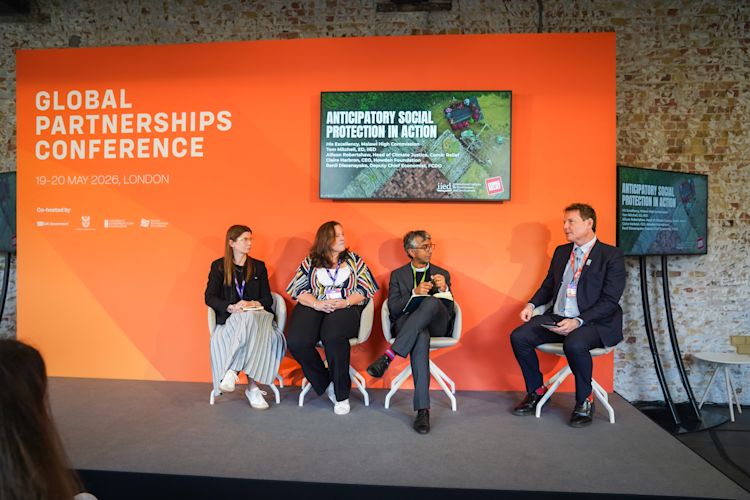
ASP is one path forward, but more importantly, it represents a broader shift in mindset. This work is also about building the partnerships needed to deliver change at scale. Recently, I had the privilege of co-leading an official side event at the Global Partnerships Conference in London, where FCDO and its co-hosts brought together diverse actors to build new international coalitions to tackle shared climate and development challenges. It was a powerful reminder that no single sector can solve this alone.
If we can align our efforts, build meaningful partnerships, and centre the needs of communities, we can do more than respond to the climate crisis. We can transform how resilience is built for generations to come.
We hope you will join us. Contact: Partnerships@comicrelief.com(opens in new window)
Written by Allison Robertshaw, Head of Climate Justice, Comic Relief.