Share with:


This blog was written by Ciara Watson, Communications Officer working with Comic Relief’s Shifting the Power programme. This programme is co-funded with the FCDO, with support from Anchor Partners, STAR Ghana Foundation, the West African Civil Society Initiative (WACSI), the Zambian Governance Foundation (ZGF), and Tilitonse Foundation.
“I am Ghanaian, proud Ghanaian. There are certain things from my community that I understand that someone from Ireland or someone from Slovakia wouldn’t understand.”
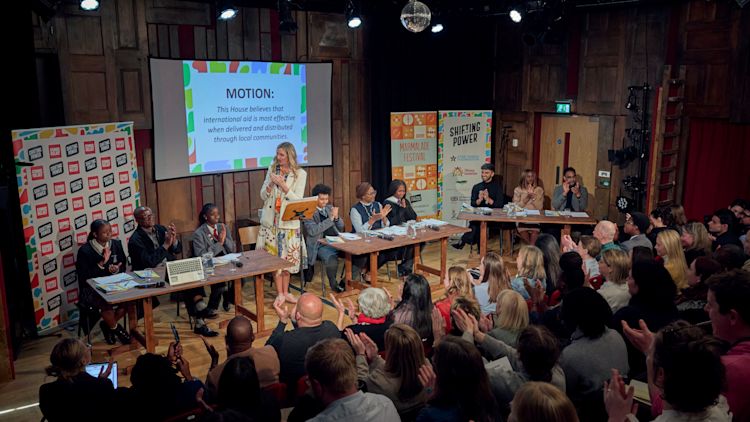
These were the powerful opening words from Natara, a secondary school debater speaking at a Comic Relief organised side event on the fringes of the prestigious Skoll World Forum. Her team were going head-to-head with a rival team, both composed of two young people and one sector thought leader, debating the motion: “This House believes that international aid is most effective when delivered and distributed through local communities.”
Critically, the arguments presented by each team were dictated by the young people themselves, with the adults in each team following suit. This was a live experiment in giving young people the floor, the mic, and the script to discuss what many of us adults in the room spent our days and careers thinking about.
The debate itself was intentionally designed to interrogate and nuance even widely held positions. It invited the audience (largely sector professionals) to sit with discomfort, contradictions, and unresolved questions. Before the debate commenced, the audience voted overwhelmingly in favour of the motion. Game over? Not quite. What followed surprised many of us…

What resonates – facts or fears?
The team in favour of – essentially locally-led development – argued that international aid does not fail from a lack of expertise, it fails from information distance. Robert White, CEO of the Tilitonse Foundation, picked this up by highlighting that while international actors leave at the end of project cycles, communities remain: “Development success is not a project outcome. It is an institutional outcome. And institutions must be local to ensure sustainability.” These points landed strongly, with nods of recognition across the room.
But the opposition team also came ready to argue. Corruption, accountability failures, and mismanagement featured prominently in the opposition argument, but also implicitly accepted by the proposition in their defense. As stakeholders in the sector, we know that risk and corruption equally afflict international and local organisations alike, and that concerns around corruption in local organisations are more often a handy excuse to maintain international control of money and power.
This raised the question: if these arguments were researched, as they clearly were, where did that research lead them? Academic literature? Social media commentary? Sector content? Or increasingly, algorithm-shaped content and AI-generated summaries that surface the most repeated framings of international aid?
This is not to diminish the effort of the debaters. Instead, it raises a broader question about the narratives young people are encountering and internalising about international development. If corruption is the loudest story told, what does that say about what our sector amplifies, challenges, or leaves uncontested?
To counter these claims, the debaters on the proposition team repeatedly brought arguments back to deeply personal ground: “Would you want a stranger helping you? Or would you want your mum, your sister, your friend to help you? They know me better than anyone!” This emphasis was significant: it translated abstract systems debates into something relatable and emotionally legible. It made me wonder whether, as a sector, we should do better at connecting the realities of communities in the Global Majority with the everyday relationships and experiences people in the UK understand.

A plot twist… and a bigger question
By the end of the debate, the winner was announced: *DRUMROLL* Team opposition won! The result did not reflect that the room rejected locally led development, far from it. It showed that nuance had been taken seriously. As Samir Patel, Comic Relief CEO and head judge on the panel, reflected: “A lot of what we thought about [when deciding] was who was rebutting, who was debunking, who was making points, counterarguments, and so forth. It feels like we need a lot more of this from the adults in the world right now, so it is amazing to see it in our young people.”
As the session closed, Tania, Head of Shifting the Power at Comic Relief, reminded us: “The stories that we tell and the narratives we weave are extremely powerful.” As I packed up our equipment and hurried to catch the train back to London, a thought lingered with me: the event was a success, thank the heavens, but where do we go from here? How do we sustain this kind of youth engagement beyond a single, powerful moment? How do these young people bring these conversations into their own lives and peer networks? How do we ensure young people are exposed to the real facts of how things work in our sector, and bust myths that circulate and capture people’s imagination? And how do we meet them there?

In the days and weeks to come, I would be coordinating our comms outputs from the event across LinkedIn and Instagram: will these reach beyond our sector bubble to those young people’s friends, families, and communities? If we want young people genuinely invested in locally led development, perhaps we need to move beyond platforming them as speakers and towards deeper co-creation. Or perhaps the answer is a response to that call for greater relationality: is there a way to foster longer-term connections between young people in the UK and the communities Shifting the Power works alongside, so advocacy is rooted in solidarity and grounded realities rather than Googled arguments.
This debate felt like a spark of new energy, a bubble-popping moment that brought in voices we don’t usually hear in this way. But, of course, shifting power is not about one-off events or neat conclusions. It is about sustained discomfort, continuous learning, and shared ownership. Our task now is to move beyond platforming towards co‑creation, and beyond momentary engagement towards solidarity. This debate showed what is possible, but we need to build the conditions – structures, mindsets, relationships, and language – to sustain them.