Share with:


Convened as part of the Shifting the Power Programme, the Pan‑African Debates brought together university students from Zambia, Malawi, and Ghana to critically examine how power operates within international development systems. Through a series of national and regional debates, young people engaged directly with questions of local leadership, accountability and community ownership, culminating in a regional grand finale at the Parliament of Ghana in Accra.
This blog was written by Fatima Mawele, Communications and Advocacy Specialist at the Zambian Governance Foundation (ZGF), who accompanied Team Zambia to the grand finale and shares her reflections on the experience in this piece.
There are moments in work and life that stay with you not because of how they end, but because of what they reveal. The recently concluded Shifting the Power (STP) Pan-African Debates are one of those moments for me.
They were not just debates in the traditional sense. They were part of a carefully designed regional learning process convened through the Shifting the Power Programme, a partnership between the Zambian Governance Foundation, Tilitonse Foundation, the West Africa Civil Society Institute (WACSI), STAR Ghana Foundation, Comic Relief and the UK’s Foreign, Commonwealth, and Development Office (FCDO). These organisations created a space where young people from Zambia, Malawi and Ghana could engage seriously with one of the most important questions in contemporary development: what does it really mean to shift power?

What the debates were really trying to do
At the heart of these debates, the simple but reflective intention was to move young people from just being observers of development discourse into being active interrogators of it.
The debates were structured around the core principles of #ShiftThePower, a movement that challenges traditional development models that concentrate decision-making in external institutions and instead advocates for approaches that prioritise local leadership, community ownership and contextual knowledge.
The motions were deliberately designed to push participants to think critically about questions that sit at the centre of development practice today. Questions such as who truly holds decision-making power in development processes, whether communities are meaningfully involved in shaping interventions, and how accountability is defined when resources and priorities are set externally.
More importantly, the debates asked participants to reflect on whether current systems of development genuinely enable transformation, or whether they reproduce existing inequalities in more subtle ways. These questions were grounded in real tensions that exist within development spaces, between donors and implementers, between global frameworks and local realities, and between well-intentioned programming and lived experience.

The journey to the grand finale
What made the process particularly meaningful was the way it unfolded across different national contexts before ending in a regional final.
In Zambia, the national debates brought together four universities, culminating in a final where the Copperbelt University emerged as the national champion after a series of rigorous and closely contested rounds.
In Malawi, the process was even more expansive, involving six universities. After a series of engaging debates, the Lilongwe University of Agriculture and Natural Resources (LUANAR) advanced as the national champion.
In Ghana, four universities participated in equally competitive rounds, with the University of Ghana ultimately emerging as the national champion.
Each of these national processes reflected the realisation that the questions being asked under STP are not isolated or country-specific. They are shared across contexts, even if they manifest differently depending on local realities.
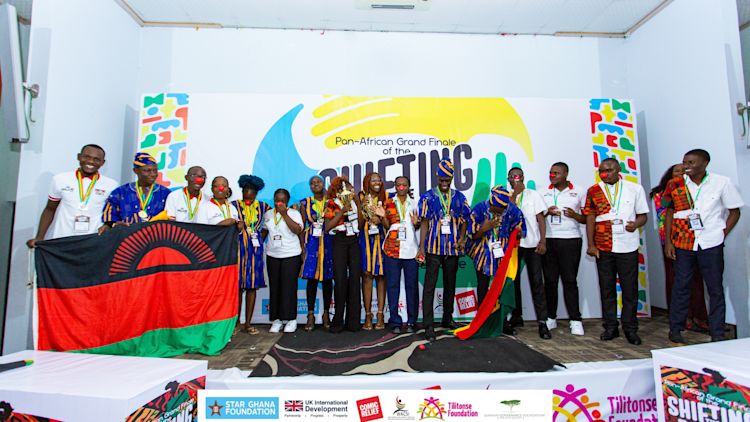
The national champions then advanced to the grand finale, where Zambia (represented by Copperbelt University), Malawi (represented by LUANAR), and Ghana (represented by the University of Ghana) met in a regional intellectual exchange that brought the entire process into sharper focus. This took place at the Parliament of Ghana, in Accra.
The final stage was less about competition in the conventional sense and more about convergence. This is because three different national contexts came together to engage with a shared set of ideas about power, development and agency.
What unfolded was a set of structured but deeply engaging exchanges that reflected the complexity of Shifting the Power in practice. Participants interrogated whether current development systems truly enable local leadership, how accountability should be understood when funding flows externally, and what meaningful participation looks like beyond consultation.
There were also deeper reflections on the role of institutions and whether civil society organisations, donors, and governments are genuinely shifting power or simply adapting existing models to appear more inclusive.
Each team brought perspectives shaped by their own national experiences, and it was this diversity that gave the debates their richness. The conversations were not about arriving at a single correct answer, but about exposing the tensions and possibilities within the idea of shifting power itself.

What these debates revealed
After a series of intense and well-presented arguments, the University of Ghana took the cup home. Nevertheless, one of the most important outcomes of the entire process was not a final score or ranking, but the clarity with which young people engaged with the concept of Shifting the Power.
What became evident throughout the process is that STP is not an abstract framework when placed in the hands of young people. It becomes something immediate and interrogative. It raises questions about whose knowledge is valued, whose voices are included in decision-making, and how power operates in both visible and invisible ways within development systems.
A personal reflection on what STP means in practice
From my perspective, working within the Zambian Governance Foundation, this experience added a meaningful layer to ongoing reflections about what it actually means to shift power in practice.
It is one thing to discuss local ownership in strategy documents and programme frameworks. It is another to witness young people actively engaging with these concepts, questioning them, and expanding them through dialogue.
What stood out most was not just the content of the debates, but the seriousness with which participants approached the idea of power itself. They were not treating it as a standalone academic concept. They were treating it as something real, something that shapes their environments, and something that can be reimagined.
This is where the true value of the STP debates lies. Not in replication of arguments, but in the emergence of critical engagement with one of the most important ideas in development today.

What must continue
Although the debates have formally concluded, the conversations they initiated should not end here.
The ideas explored in these spaces need to continue evolving within universities. They also need to extend into civil society spaces, policy environments and community dialogues where decisions about development are actually made.
Because if Shifting the Power is to move from concept to reality, it cannot remain confined to institutional spaces alone. It must be continuously interrogated, tested and shaped by those it ultimately affects.
By Fatima Mawele, Communications & Advocacy Specialist
Watch the STP Pan-African Debates highlights video here: